Sunday, December 13, 2020

Cold-Miser and Mud-Miser in The Great War (Final Paper Summary)

If you’ve seen the Christmas special “The Year Without a Santa Claus” or been on social media enough to see the makeup trend, you know that the Miser Brothers in this special represent the hot and the cold and control the weather.  (Their song is a bop, even more than I remember!)  Santa can deal with Heat-Miser and Snow-Miser, but we’re going to talk about Cold-Miser and Mud-Miser, the infamous World War One weather duo.

Heat-Miser and Snow-Miser

in my paper, I examined the poems “Winter Warfare” by Edgell Rickword, “Exposure” by Wilfred Owen, “The Song of the Mud” by Mary Borden, and “The Battle of the Swamps” by Muriel Elsie Graham (I did a previous blog post on this poem too).  These poems illustrate that at times a soldier’s greatest enemy was not man or weapons made by men, but cold and muddy battlefield conditions created by nature.  For each poem, I first analyzed it in its own context, then in the context of personifying the cold or mud.  To keep this post a reasonable length, I included only my analysis of “The Song of the Mud” since it was my favorite to work on and some of the outside research I did. 


In World War One, the lingering effects were seen as infamously awful mud sometimes described as the “liquid grave” for the armies (More, et. al. 2020).  A famous World War One poem by Mary Borden, titled “The Song of the Mud,” illustrates the conditions at the front caused by “invincible, inexhaustible mud” (Borden, line 6).  In Borden’s poem, the mud is everywhere, from hills and valleys to covering soldiers head to toe to jamming the motors of machines.  Like many Great War poets, Borden creates a dichotomy between beautiful imagery and reality to highlight how awful the mud really was through irony.  She imagines a man “crowned with a helmet of mud,” bringing to mind an image that is regal and dignified yet covered in filth (Borden, line 13).  The mud “covers the hills like Satin” while being “impertinent”, “intrusive,” and “unwelcome” (Borden, line 19).  It is “filthy” and “putrid” but also “beautiful glistening golden” (Borden, lines 32 & 48)  At some points, the poem actually reads a bit like a love poem, albeit an ironic one, about a terrible but beautiful man.  There’s a feeling that the mud wants only to love these men in a strange, erotic way.  This is especially evident in the third stanza where Borden uses words and phrases such as “slimy voluminous lips” that “slowly, softly, and easily” absorb men’s lives (Borden, lines 25 & 27).  The mud sounds like a deadly lover.


A soldier stuck in the mud


Like the previously mentioned poets, Mary Borden also employs personification in her poem and anthropomorphizes the mud.  The mud as a lover is just one example of this.  The entire poem makes readers feel like the mud is alive, and beyond that, that the mud has understanding and intent to kill.  In the third stanza, she writes about the mud mixing itself into food and crawling into machine motors.  While readers logically know mud is an inanimate object, Borden stresses the danger of it by making it seem like a living enemy without morals or “respect for destruction” (Borden, line 26).  In some ways, she even makes the mud seem more dangerous than any human.  Unlike a flesh and blood soldier, the mud is “inexhaustible” and “soaks up the power” of the armies in a “monstrous distended belly” (Borden, lines 6, 29, & 34).  Not only has Borden crafted a tangible human enemy, but she goes a step further to create an insatiable monster with human traits.  Remember Fussell’s ‘us versus them?’  ‘Them’ is now a human-like monster with the desire to harm, something readers will understand as dangerous more than they would understand mud as dangerous.


Mud on a battlefield

Soldiers Rickword and Owen attest to the cold in “Winter Warfare” and “Exposure” based on their own experience, and though Borden and Graham lack combat experience, they likewise explain a very real enemy in World War One.  The Battle of Passchendaele is just one example of how deadly the muddy and swamp-like conditions of the battlefield could be.  Artillery fire loosening the ground and days of relentless rain, combined with a water table only a few feet below the ground fostered the perfect environment for a muddy swamp.  Weapons and soldiers, sometimes alive, would sink into the mud and drown (Shuster).  George Pearkes, a soldier in the battle, shared his story many years ago and described how soldiers were “drowned or suffocated by the clammy mud.”  He said it was the mud more than the fighting that made achieving their objective such a challenge (“The Murderous Mud of One First World War Battlefield.”).  Unfortunately, mud was not exclusive to Passchendaele.  By nature, trench warfare created the ideal environment for mud, and the trenches were full of it.  Drainage was difficult, and continuous rain would fill trenches with mud and water.  Not only that, but it was often cold water falling and filling the trenches, and the cold was, as previously illustrated, quite dangerous (Schlenoff, 2016).  


From the Battle of Passchendaele

The essence of my final paper is really how poets make nature seem human-like as a way to understand what is happening to them.  It’s hard to be angry at mud or snow or rain, but a mud monster or a “Captain Cold” like Rickword writes about creates a tangible enemy.  In a part of the paper not included, I talked about the 'us versus them' habit that Fussell wrote about.  Personifying nature allowed people to imagine a ‘them.’  It was something to struggle and fight against.


As a sort of conclusion for this course, I want to come full circle to irony which was one of the first things we ever talked about and a theme running through just about every part of WWI.  All of the poems I looked at personified or anthropomorphized an aspect of nature to make it more understandable as an enemy.  I find this ironic because it is the exact opposite of what people generally do to an enemy, trying to dehumanize them in an attempt to make them easier to kill.


Sunday, December 6, 2020

Description of Final Paper

 Topic/Theme: Battlefield conditions

Question: How does poetry highlight the non-human enemy of battlefield conditions in the First World War?


I got this idea because I was really interested in the poem “Song of the Mud” that Dr. Ruzich suggested in class.  In my paper, I want to talk about the non-human elements of the war that contributed to death and terrible conditions.  Specifically, I am thinking of the muddy swampiness of the battlefield.  “The Battle of the Swamps” and “Song of the Mud” both personify mud, making it feel like an actual enemy combatant rather than just nature.  So, I want to talk about that personification and how it emphasizes that German’s weren’t the only enemy soldiers faced in the trenches and in battle.

Related to that, I also want to look at the non-human enemy of the weather conditions through poems like “Futility.”  This poem, for instance, personifies the warm sunlight in contrast with fatally cold conditions.  It highlights the enemy in a different way but sticks to the theme of a non-human enemy.  I might use “Exposure” instead or in addition to “Futility.”  Of course, “Winter Warfare” needs to go in too, since it really personifies cold weather conditions with the “Colonel Cold” character.


Poems to Use

  1. “The Battle of the Swamps” by Muriel Elsie Graham (Scars p. 41-43)

  2. “Song of the Mud” by Mary Borden (Online/Dr.R’s blog)

  3. “Futility” by Wilfred Owen (Penguin p. 54)

  4. “Exposure” by Wilfred Owen (Penguin p. 55-56)

  5. “Winter Warfare” by Edgell Rickword (Penguin p. 53)


What I need help with…

  1. If anyone has any other suggestions for poems to use about battlefield conditions, I would love to hear them! 

  2. Does this question seem expansive enough?  Does it need to be narrowed down more?  Any ideas about the scope of the paper being too large/small are appreciated.  I was thinking about including something about the decaying bodies if this is too narrow, but I don’t want to get out of hand.

Sunday, November 15, 2020

The Ethics of Battlefield Tourism (Or, How Many Time Can I Say "Battlefield" in One Post)

High Wood by Philip Johnstone

Ladies and gentlemen, this is High Wood,

Called by the French, Bois des Fourneaux,

The famous spot which in Nineteen-Sixteen,

July, August and September was the scene

Of long and bitterly contested strife,

By reason of its High commanding site.

Observe the effect of shell-fire in the trees

Standing and fallen; here is wire; this trench

For months inhabited, twelve times changed hands;

(They soon fall in), used later as a grave.

It has been said on good authority

That in the fighting for this patch of wood

Were killed somewhere above eight thousand men,

Of whom the greater part were buried here,

This mound on which you stand being…

Madame, please,

You are requested kindly not to touch

Or take away the Company's property

As souvenirs; you'll find we have on sale

A large variety, all guaranteed.

As I was saying, all is as it was,

This is an unknown British officer,

The tunic having lately rotted off.

Please follow me - this way …

the path, sir, please

The ground which was secured at great expense

The Company keeps absolutely untouched,

And in that dug-out (genuine) we provide

Refreshments at a reasonable rate.

You are requested not to leave about

Paper, or ginger-beer bottles, or orange-peel,

There are waste-paper-baskets at the gate.


High Wood (called Bois des Fourcaux by the French, a name misprinted on British maps) was the site of fighting from July to September of 1916 as part of the Battle of the Somme in France.  High Wood was captured by the British after months of fighting; it was one of the last major woods in the Somme offensive to fall.  Like other WWI battlefields, High Wood was turned into a cemetery and memorial place (pictures below).*  There is a lot more information about this battle, including a day by day account of events, that can be found here.


High Wood can be seen in the background behind the cemetery.*

A restored memorial stone at High Wood.*


What made this battle particularly terrible (I mention this to reinforce the irony of the poem) is that the Germans were fortified in the woods with machine guns while the British approached from grain fields.**  It doesn’t take a genius to realize that the people in open fields are at a militaristic disadvantage compared to the ones hiding in the woods.  In short, the battle for High Wood proved to be no less terrible than the rest of the horrific events of the First World War.

 The Calvary preparing to charge the forest at High Wood.*

Johnstone, whose real name was John Stanely Purvis, wrote this poem in 1918, a few years after the Battle of the Somme but before battlefields were inundated with tourists.  Much like Hardy’s “Channel Firing,” “High Wood” predicts a remarkably accurate future.  Based on Johnstone's description of a soldier whose tunic has just rotted off, I believe he is speaking of the near future. Really, he is describing a permanent future where battlefields are tourist attractions. 


This poem describes people touring the High Wood battlefields, narrated by a tour guide who rattles off statistics about death and war without hesitation.  Notably, the High Wood battlefield has never been cleared of bodies and debris like some others, but this tour guide apparently doesn’t care.  He doesn’t seem bothered that “this mound on which you stand” is where 8,000 dead men are buried, shifting immediately from describing the battlefield to asking a woman not to take things from it… after all, his company wants to make a profit on souvenirs.  What’s the point of war if not to gain some profit, and if you didn't make enough during the war, no worries, plenty is left behind.


I also think his use of “Company” as a proper noun is interesting.  A company is a term for a group of soldiers, so he could be saying that the things on the battlefield are the property the soldiers who fought there.  This actually has an almost kind tone where the guide requests that they not take things from the dead.  Personally, I read this poem as a satire, mocking the desire of the living to see where men died and providing an indirect commentary about how wrong that is, so that interpretation doesn’t work for me.  I think the “Company” refers either to an actual company that has taken advantage of war for profit, the way weapons manufacturers do, or the government that continues to use these men for their own purposes, even in death.


Whatever you interpret the “Company” to be, the overarching theme of the poem is clear.  This author imagines battlefields becoming nothing more than tourist attractions, complete with souvenirs and snacks.  As I mentioned earlier, he was ultimately correct.  To this day, many battlefields (from a lot of different wars) have become major draws for tourists.  However, as a general rule, I think these places are regarded with much more respect than Johnstone would lead readers to believe.  Nonetheless, I think he expresses a very real fear, especially from the perspective of a war veteran. No one wants to see the place where his friends died, where he was wounded himself, become a trivialized location. Dare I take a Fussell stance and say Johnstone saw the battlefield of High Wood becoming a theater?


Philip Johnston is a pseudonym for John Stanley Purvis, a First World War veteran who was wounded at the battle of High Wood.  He survived the war, though his younger brother did not.  Johnston’s true identity was not learned until his death in 1968.^  “High Wood” is an interesting perspective on the preservation of war battlefields and begs the question, what is the place of tourists on fields of war, and how can battlefield tourism be done respectfully? I think battlefield tourism can be respectful. I think it can be educational. I think that relatives of those who died there have a right to visit, the same way they can visit a cemetery. I also think Johnstone probably feels the same way, and has a more nuanced view of battlefield tourism than this poem would let on.


Tourists visiting the High Wood battlefield in 1919, after the war.  Some were
relatives of men who died there and went on pilgrimages to see where
their loved ones had died.^^


*https://www.ww1battlefields.co.uk/somme/high-wood/ 

**https://allpoetry.com/High-Wood

^https://yorkcivictrust.co.uk/heritage/civic-trust-plaques/john-stanley-purvis-1890-1968/

^^https://greatwar.nl/frames/default-tourism.html 


Thursday, November 12, 2020

The Flowers of Joyful Youth: An Analysis of "From a Trench" by Maud Anna Bell

 **Repost from class blog**

From A Trench by Maud Anna Bell

Out here the dogs of war run loose,
Their whipper-in is Death;
Across the spoilt and battered fields
We hear their sobbing breath.
The fields where grew the living corn
Are heavy with our dead;
Yet still the fields at home are green
And I have heard it said:

That there are crocuses at Nottingham!
Wild crocuses at Nottingham!
Blue crocuses at Nottingham!
Though here the grass is red.

There are little girls at Nottingham
Who do not dread the Boche,
Young girls at school in Nottingham
(Lord! How I need a wash!).
There are little boys at Nottingham
Who never heard a gun;
There are silly fools at Nottingham
Who think we’re here for fun.

But here we trample down the grass
Into a purple slime;
There lives no tree to give the birds
House room in pairing-time.
We live in holes, like cellar rats,
But through the noise and smell
I often see the crocuses
Of which the people tell.

Why! There are crocuses at Nottingham!
Bright crocuses at Nottingham!
Real crocuses at Nottingham!
Because we’re here in Hell.


How a Rock Opera Connected me to a WWI Poem: An Analysis of "Gethsemane" by Rudyard Kipling

**Repost from class blog**

Gethsemane by Rudyard Kipling

The Garden called Gethsemane
In Picardy it was,
And there the people came to see
The English soldiers pass.
We used to pass—we used to pass
Or halt, as it might be,
And ship our masks in case of gas
Beyond Gethsemane.

The Garden called Gethsemane,
It held a pretty lass,
But all the time she talked to me
I prayed my cup might pass.
The officer sat on the chair,
The men lay on the grass,
And all the time we halted there
I prayed my cup might pass.

It didn’t pass—it didn’t pass
It didn’t pass from me.
I drank it when we met the gas
Beyond Gethsemane.


In Andrew Lloyd Webber’s rock opera Jesus Christ Superstar, the character of Jesus sings a song titled Gethsemane (I Only Want to Say). That song popped into my head immediately upon seeing this title listed in Penguin and refused to leave for several days.  You can see the lyrics by following this link and listen to the song on YouTube here.  I recommend listening to the song (it echoes Jesus's actual sentiments in the Biblical text) while reading Kipling's poem. The similarities are obvious, and I want other people to have it stuck in their heads too. 

Being that Jesus Christ Superstar is one of my favorite musicals and Gethsemane one of my favorite songs from it, I was immediately drawn to this poem. Of course, the canonical basis for Kipling's poem and Webber's musical is the Bible, specifically the Garden of Gethsemane where Jesus prayed the night prior to his death.* I am fascinated when people use a well-known story to improve the understanding of a separate event, and because of my love of Jesus Christ Superstar as well as my upbringing in a Christian church, I realized right away that Kipling’s poem is deliberately written to parallel the events leading to the crucifixion of Christ. 

The first stanza sets the scene of soldiers marching through Picardy, perhaps stopping to rest, and being observed by the French people residing there. Picardy was the site of much violent fighting from 1914-1918.* Knowing this gives the line “The English soldiers pass” a sort of double meaning. “[P]ass” could refer to traveling through an area or more morbidly, passing to the next life. 


As I read the next stanza, I picture Kipling’s Garden as the land just before soldiers would reach the fighting and likely death, similar to how in the Bible the Garden is one of the last places Jesus spent time before his death. In Matthew 26.39, Jesus prays “O my Father, if it be possible, let this cup pass from me."* This is shown in the image above**. Like Jesus in Gethsemane, this soldier is also asking for the cup that is representative of death to pass from him. Both men are in a peaceful garden, literal or metaphorical, knowing their inevitable death waits beyond. Not only death but painful death- crucifixion for Jesus, and gas for the man in the poem. In the third stanza that death arrives. Just as the cup didn’t pass from Jesus, nor does it pass from the soldier who dies from gas after leaving his Garden of Gethsemane.

Overall, I was surprised and captivated by Kipling's boldness in comparing a soldier’s sacrifice to the sacrifice of Jesus, a revered figure in Christianity and other major religions. However, rather than interpreting this as trivializing Jesus’s plight, I see this poem as elevating the plight of soldiers’ to the level of Christ. Though not directly, Kipling seems to be saying that a soldier who sacrifices their life, and more than that, does so knowing and resigned to the fact that they must die, is at the same level as the son of God. I think that this is an incredibly powerful sentiment. In Gethsemane, Kipling simultaneously applauds the bravery of soldiers, suggests a tragic necessity to their sacrifice, and reflects on the horror of war and death, all by alluding to the known story of Christ’s crucifixion.

In the early 1900s when this poem was written and published, people would have understood the biblical reference immediately. While I used a song from a rock opera to relate to it, those with any familiarity with the story of Jesus's death would likewise be able to understand and draw their own conclusions about Rudyard Kipling's Gethsemane.


*Radcliffe, J., & McGivering, J. (2011). “Gethsemane.” Retrieved September 9, 2020, from http://www.kiplingsociety.co.uk/rg_gethsemane1.htm

**Manly Poems – Gethsemane by Rudyard Kipling. (2010, October 24). Retrieved September 9, 2020 from https://anirishmanabroad.wordpress.com/2010/10/24/manly-poems-gethsemane-by-rudyard-kipling 

Sunday, November 8, 2020

Oh to Be a Carrion Fly: An Analysis of “The Dancers” by Edith Sitwell

The Dancers by Edith Sitwell

The floors are slippery with blood:
The world gyrates too. God is good
That while His wind blows out the light
For those who hourly die for us –
We still can dance each night.

The music has grown numb with death –
But we will suck their dying breath,
The whispered name they breathed to chance,
To swell our music, make it loud
That we may dance, - may dance.

We are the dull blind carrion-fly
That dance and batten. Though God die
Mad from the horror of the light –
The light is mad, too, flecked with blood, -
We dance, we dance, each night.


If you just read “The Dancers” by Edith Sitwell, you might have experienced the same shock I did when I realized this poem was not about women but about flies that feast on dead flesh. The author, unlike many female First World War poets, is actually quite famous. She is more known for her World War Two poetry that is "of tragic grandeur and intensity.”* A lot of her works were considered experimental, drew heavily on religion, used unique rhythms, and employed “private allusions.”** The carrion-fly is not a private allusion, however, it does make you wonder what exactly the author was thinking when she wrote “The Dancers.”

Edith Sitwell

When I first read Sitwell’s poem, I immediately thought it was a piece about women that echoed the sentiments of many other poets - women and those on the homefront are living a happy, carefree life while men die in the trenches. When she talks about “those who hourly die for us” I immediately assumed she meant soldiers dying for the people at home who “can still dance each night” because of that sacrifice. I only become further invested in that metaphor with the idea of “we will suck their dying breath.” It reads like the author believes the people at home are stealing life away from the soldiers who are fighting and dying for them.

But that isn’t what the poem is about, as the final stanza reveals. The poem is about the carrion-fly (pictured below) eating the flesh of the dead, dancing on the flesh of the dead. Or is it?  Maybe my first interpretation holds true.  Perhaps Sitwell is comparing women and those who stay at home to the carrion-fly because they both are getting to dance and be happy only because people are dying. Death is necessary for their survival. It’s a bleak interpretation and somewhat Sassoon-like in that it doesn’t speak very highly of those at home.  Honestly, I think "The Dancers" could be read literally or metaphorically, but I personally prefer the bleakness of the metaphorical interpretation.

A carrion-fly.  I'll spare you the pictures of them on actual decaying flesh.

To conclude, there is one specific part of the poem that I want to highlight.  I found the idea of “the light” particularly compelling.  If God’s wind is blowing out the light, then the light must be human life blown out by God on the battlefield.  Based on the legend of the three Fates cutting the string of life that I talked about in my post on “The Ballad of the Three Spectres” by Ivor Gurney, I interpret “the light” to be the human soul being snuffed out by God. Carrying that interpretation to the final stanza where Sitwell says “Though God die/Mad from the horror of the light-/The light is mad” continues the bleak theme that was started when Sitwell compared those on the homefront to carrion flies. 

This poem puts on the page the idea that God is dead, something Fussell and the films discussed.  Now, not only is God dead, but he is killed by that madness caused by seeing how terrible the human soul is. The human soul is insane and so terrible it has driven God to fatal insanity.

*https://www.britannica.com/biography/Edith-Sitwell
**https://www.poetryfoundation.org/poets/edith-sitwell

Sunday, October 18, 2020

"WHAT ARE YOU DOING IN MY SWAMP!?"

“The Battle of the Swamps” by Muriel Elsie Graham

Across the blinded lowlands the beating rain blows chill,
The trenched earth turns to water, the shell-holes ooze and fill,
A tragic land where little that’s sweet or sane survives –
O hungry swamps of Flanders that swallow up men’s lives!

O numbing nights of Flanders, whose cold breath cannot quench
The grim enduring courage that holds each mud-fouled trench,
That struggles stiffly forward to meet the shattering guns –
O bitter swamps of Flanders that rob us of our sons!

Yet in the sheltered homeland that lies such worlds away,
What shrinking hearts are braving that suffocating clay!
And when on roof and window the rain beats, then – O then,
O deathless swamps of Flanders, our hearts are with our men.


A picture of Muriel Elsie Graham.

Unfortunately for WWI soldiers, they were not Shrek, a semi-friendly, swamp-inhabiting ogre.  Unfortunately for me, Muriel Elsie Graham is a female poet, so not much is known about her. Virtually the only information I can find about Graham is the above picture.* From that photo, that I assume is her but cannot verify, she seems to have been a nurse in the First World War. That would put her near battle, and she certainly would have seen injured men during the war and been familiar with battlefield conditions. Even without knowing much about the author, there are still a few big takeaways from this poem.

The third time I read it, I realized Graham never mentions enemy soldiers like so many other WWI poems. This surprised me, because I automatically used enemy combatants in my first interpretation, but their absence is actually incredibly significant. “The Battle of the Swamps” reads like a description of battle. It talks about “swallowing up men’s lives” and “enduring courage” and “tragic land.” Phrases like that make me think about fighting an enemy, but it’s not the German’s that Graham writes about. It’s the swamps, and by extension. the environmental conditions of the battlefield. She describes “beating rain,” “numbing nights,” and the “mud-fouled trench.” These conditions are the enemy; this is what kills the soldiers.

To emphasize that point, I did some outside research into what battlefield and trench conditions looked like in WWI.  In class, we have talked about flooding trenches and battlefields that were atop swamps, but seeing it strikes a different chord.  I collected some pictures below.

The conditions at Flanders, the location
referenced in the poem.

A man in the trenches.  The man-made holes became
their own swamps.

Soldiers carrying the wounded through mud
at Passchendaele. 

Additionally, here is a link to an interesting article about the conditions at Passchendaele, a battle infamous for its terrible mud. 


Another part of the poem that I would like to highlight is the final stanza, where readers are taken away from the battlefield and to the homeland (probably England). Since this poem is authored by a woman, this change in scenery makes complete sense. Graham says “when on roof and window the rain beats… our hearts are with our men.” I think these two lines are very powerful and express an idea shared by many women: they are suffering through the war too. However, she also captures the nuance of that statement in a previous line when she describes the homeland as “sheltered.” She recognizes that the people at home are not suffering the way soldiers are, but that they aren’t exactly having a grand time either.

The final part of the poem I will touch on is the repeated pattern of the final line of each stanza. “Hungry swamps” that “swallow up men’s lives” is self-explanatory and accurate, but interestingly, it personifies the swamps and makes them feel more like an actual enemy. The second stanza ends with “bitter swamps… that rob us of our sons.” Again this personifies the swamps, almost demonizing them.  Then, it is the last stanza that confuses me.  It says “deathless swamps… our hearts are with our men.” The last words, I talked about previously, but it is the deathless swamps line that really, really confused me.

I think I puzzled it out but would love to hear other perspectives. Deathless means without death, but more specifically means being immortal. Rather than reading that line to mean that no one dies in the swamps, I think this is saying that swamps and the men who died there are an immortal fixture in the hearts and minds of the English at home.

*https://allpoetry.com/Muriel-Elsie-Graham

Saturday, October 10, 2020

Past, Present, and Future: An Analysis of "Ballad of the Three Spectres" by Ivor Gurney

"Ballad of the Three Spectres" by Ivor Gurney

As I went up by Ovillers
In mud and water cold to the knee,
There went three jeering, fleering spectres,
That walked abreast and talked of me.

The first said, ‘Here’s a right brave soldier
That walks the dark unfearingly;
Soon he’ll come back on a fine stretcher,
And laughing for a nice Blighty.’

The second, ‘Read his face, old comrade,
No kind of lucky chance I see;
One day he’ll freeze in mud to the marrow,
Then look his last on Picardie.’

Though bitter the word of these first twain
Curses the third spat venomously;
‘He’ll stay untouched till the war’s last dawning
Then live one hour of agony.’

Liars the first two were. Behold me
At sloping arms by one – two – three;
Waiting the time I shall discover
Whether the third spake verity.


Even before the Great War, Ivor Gurney was not well. He suffered from manic-depression and had experienced a nervous breakdown, but he still went off to fight. Though he survived through the end of the war, in 1922 he was institutionalized before dying 15 years later of tuberculosis. Through it all, Gurney continued to write poetry and compose music, including “Ballad of the Three Spectres.”*

Ivor Gurney

A ballad is a form of poetry that tells a story in a series of stanzas (2 or more) that are able to be put to music and sung. Though this poem was not put to music like some of Gurney’s other works, this piece certainly tells a story.*

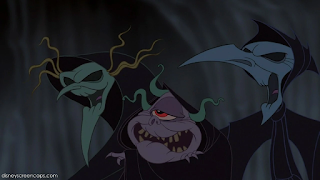
When I first read “The Ballad of the Three Spectres” I thought immediately of three Fates in the Disney movie Hercules.  

The Fates in Hercules who all share a single eye.

Of course, the legend of the Fates did not originate from an animated Disney film but from Greek mythology. According to myth, the Fates (or Moirai) are three female spinners who control the destiny of mortals, spinning the string of each person’s life and cutting it when it is time for them to die. Atropos represents the past, Clotho the present, and Lachesis the future.** A Christmas Carol by Charles Dickens is another famous literary work that tells a story through three mystical beings.

A more traditional interpretation of the three Fates
spinning the yarn of someone's life.

In Gurney’s poem, the idea of the Fates and overall tone seems to suggest a lack of control over one’s own future, and I think he was trying to convey the lack of control soldiers felt about their prospects while fighting in the war.

Diving deeper into the poem reveals more meaning. Starting in the second stanza, each spectre is given its own voice. The first seems to be commending Gurney’s bravery, but likely the spectre actually speaks in a sarcastic tone because of his references to blighty wounds. These were injuries bad enough to get a soldier sent home but not kill or seriously maim.^ Such injuries could be self-inflicted, intentionally done to survive. The spectre is saying that perhaps Gurney will do the cunning and cowardly thing to survive the war.

Then, the second spectre presents an outlook that is even bleaker, suggesting that the author will freeze to death in the mud. In other words, one fate for a soldier is to be a coward and the other is to die. It’s not a great outlook, but there’s still one other possibility. Maybe spectre three has something positive to say?

Actually, the final is the cruelest of them all, saying “‘He’ll stay untouched till the war’s last dawning/Then live one hour of agony.’” This probably refers to a common fear of surviving until the end of the war only to die, slowly, in the final days.^

These statements all relate back to the Fates as the past, present, and future. The first spectre (past) discusses blighty wounds. Gurney was wounded twice in the war, meaning at some point he was taken out of combat before returning. In a sense, blighty wounds are his past. The second Fate (present) talks about the cold and dying while in the trenches. If Gurney wrote this poem while in the trenches, he was talking about a very present fear. The final, however, looks to the future. The war has not yet reached an end. The last stanza provides an open-ended conclusion to the ballad, where Gurney must wait to see if what the third spectre says about the future is true.

In my first reading, before doing prior research, I read the words of the last spectre to have a different meaning than I discussed above. While not as literal, I took the words to mean Gurney could survive the war, only to live the rest of his life tortured by it. I really like this idea because it adds a mystical air to the piece where the spectres prediction does come true. Gurney is haunted by the war, and that combined with his other mental illnesses causes him to be institutionalized.

However you interpret this poem, I think there is an overarching theme that for soldiers there is no good fate in war, not that they really get to control their destiny anyway.


*https://www.poetryfoundation.org/poets/ivor-gurney
**https://www.greekmythology.com/Other_Gods/The_Fates/the_fates.htmlhttps://www.greekmythology.com/Other_Gods/The_Fates/the_fates.html
^https://movehimintothesun.com/2011/04/22/ballad-of-the-three-spectres-ivor-gurney/

Sunday, October 4, 2020

One Day More "Before the Battle:" An Analysis of Martin Armstrong's Poem

Like the musical Les Miserables, “Before the Battle” by Martin Armstrong tells a long story about youth going off to battle and facing death. Armstrong was a soldier in France during the war. He was born in 1882, so he would have been about 33 when he was commissioned. Interestingly, he survived the war by several decades, not dying until 1974.*

A picture of Martin Armstrong.

When I first read Armstrong’s poem (which you can read here), I thought immediately of the song “One Day More” from Les Mis. Though the musical is set in a different time and conflict, this song sets the same stage as the poem. It describes the time before the battle, men who are really boys are readying themselves to fight and enjoying the last few hours of their life.

“Before the Battle” opens on a somber note, describing the mole-like life soldiers in the trenches live and the dead land that surrounds them. It is gloomy but “memory like the rose” provides an escape. Those memories are of another life these men once led where they frolicked by rivers and enjoyed time with friends. To understand this poem one does not really need to read into the text, however, analyzing the flashback portion of the poem provides a few interesting insights.

First and foremost is the symbolism of water and the river where the men are swimming. One of the first things I learned in English class is that water and rivers are symbolic of life, a connection that highlights the lifelike and vibrant nature of these young men before going into battle. The choice of a river is interesting for another reason though. Here water is indicative of life and a positive element of the memory while at the beginning of the poem (and the end) the trenches are “waterlogged.” In WWI, water flooded trenches and made life miserable for the people in them, so it is important to note the irony that the same thing that made men so happy in one situation makes like miserable in the trenches.

Another repeated element is the willow tree. That took a little more research, but eventually I found that the willow tree, like water, represents life. It also relates to adaptability and survival since willow trees are famously resilient.** They are the epitome of bend don’t break, a necessary quality in a good soldier.

A willow tree by water.  Sometimes these trees are
portrayed as motherly and protective, like in the
Disney film Pocahontas.

Unfortunately, the happy memory in the poem concludes with the bugle calling the men to action where they form orderly rows. The individuality is gone. Bert, who dived into the river in the last stanza is just another member of the party of men. And then the memory is shattered fully when Armstrong tells us that these men “lie in narrow chambers underground.” They are dead.  Just like the opening of this poem reminded me of “One Day More” from Les Miserables, this section reminds me of the song “Empty Chairs at Empty Tables.”

Finally, the poem returns to the miserable setting described in the first stanza, emphasizing the terrible conditions of wet trenches and rainstorms.  Then it concludes with Armstrong asking for another day to enjoy “sun and leaves… and the laughing stream," but all that is only a memory.  Now is the time for battle.

Sunday, September 27, 2020

A Different Wilfred Owen: An Analysis of "Futility"

"Futility" by Wilfred Owen


Move him into the sun—
Gently its touch awoke him once,
At home, whispering of fields half-sown.
Always it woke him, even in France,
Until this morning and this snow.
If anything might rouse him now
The kind old sun will know.

Think how it wakes the seeds—
Woke once the clays of a cold star.
Are limbs, so dear-achieved, are sides
Full-nerved, still warm, too hard to stir?
Was it for this the clay grew tall?
—O what made fatuous sunbeams toil
To break earth's sleep at all?


Wilfred Owen.  What comes to mind when you read his name? If you’re like me, you might think of the grotesque descriptions of war this WWI poet is known for. Think about “Dulce et Decorum Est.” Readers are confronted with startlingly uncensored depictions of war that draw us in and keep us captivated.   Many of his pieces are like watching a car crash, horrible, but how can we look away?

“Futility” is different though. In fact, I had to make sure there wasn’t a misprint when I read that Owen authored this piece. He sounds tired, burnt out, exhausted, and the poem is shorter than many of his other works, a physical representation of that exhaustion perhaps.  "Dulce et Decorum Est," written a year earlier, is more lively, directly questioning a belief held by many people in Britain with dramatically horrifying imagery.  Reading "Futility" almost feels like reading a note someone wrote for himself.  So, I looked at a timeline of Owen’s life, wondering if there is a clear reason for this shift.  There is.

“Futility” was published in The Nation on June 15, 1918 (shown below), one of only a handful of Owen’s poems published during his life.*  Around that time, Wilfred Owen was drafting and redrafting many poems.  He was also being treated for shellshock, what we would call PTSD.  Then, with the now-familiar irony that accompanies WWI events, in the same month this poem was published, the military approved Owen's return to active service.**  I think this piece reflects well what Owen might have been feeling at that moment as he was called back into a war he didn't want to happen.

"Futility" published in The Nation.


“Futility” is an elegy, perhaps not in traditional form, but in the sense that it is written in remembrance of the dead.  The piece opens with soldiers moving a fallen comrade into the sun, hoping (though they know it is futile) that the sun will imbue him with life once again, the way it wakes people from sleep.  Maybe he’s only sleeping, the writer seems to say, even though he knows that isn't the case.

In the second stanza, Owen says that if the sun can give life to plants and put life on a planet that was once a “cold star,” surely it can do the same for a body that is still warm and already formed. When that plea fails, Owen ponders a larger question. “Was it for this the clay grew tall” alludes to the belief some people hold that man was created from clay. But what is the “this?” In my interpretation, it’s not war but death. In other words, was humanity created die? The final lines drive this message home even further: “what made fatuous sunbeams toil/To break Earth’s sleep at all?” If human life is going to end, then why bother to have it at all?  This piece is a break from Owen's other poems that decry war, but it is possible to interpret the "this" as war instead.  Maybe "this" is both war and death.

It wasn't until after I read this whole poem that I looked at the title, and it was like the moment in a movie or book when suddenly everything makes sense.  Futility. Uselessness, pointlessness.   At first, the futility is trying to revive the dead soldier, but the message is larger than that. Owen, shell-shocked, soon to be redeployed, a staunch opponent of war, expresses not the futility of war but the futility of human existence when death is an inescapable reality.

Sunday, September 20, 2020

Even the Dead Have Not Seen the End of War: An Analysis of "Channel Firing" by Thomas Hardy


Channel Firing by Thomas Hardy

That night your great guns, unawares,
Shook all our coffins as we lay,
And broke the chancel window-squares,
We thought it was the Judgment-day

And sat upright. While drearisome
Arose the howl of wakened hounds:
The mouse let fall the altar-crumb,
The worms drew back into the mounds,

The glebe cow drooled. Till God called, “No;
It’s gunnery practice out at sea
Just as before you went below;
The world is as it used to be:

“All nations striving strong to make
Red war yet redder. Mad as hatters
They do no more for Christés sake
Than you who are helpless in such matters.

“That this is not the judgment-hour
For some of them’s a blessed thing,
For if it were they’d have to scour
Hell’s floor for so much threatening....

“Ha, ha. It will be warmer when
I blow the trumpet (if indeed
I ever do; for you are men,
And rest eternal sorely need).”

So down we lay again. “I wonder,
Will the world ever saner be,"
Said one, “than when He sent us under
In our indifferent century!”

And many a skeleton shook his head.
“Instead of preaching forty year,”
My neighbour Parson Thirdly said,
“I wish I had stuck to pipes and beer.”

Again the guns disturbed the hour,
Roaring their readiness to avenge,
As far inland as Stourton Tower,
And Camelot, and starlit Stonehenge.


Woodrow Wilson is famously quoted saying “[t]his is a war to end all wars," a view that is countered by philosopher George Santayana who said, "[o]nly the dead have seen the end of war.”* In "Channel Firing," Thomas Hardy makes the somber assertion that even for the dead, there is no end to war. In many religions, the dead live on in one form or another, sometimes waiting for a final Judgement Day as Christians believe. Even for those who don’t believe in an afterlife, the message of this poem is clear: war was here before us and it will be here long after we are gone.


"Channel Firing" is a conversation between the dead and God and an ironic conversation at that. In the first stanza, the sounds of guns from a training drill awaken the dead in coffins who believe Judgement Day, the prophecized time when God will judge both living and dead, has come. What immediately strikes me about this poem is that these men are not WWI veterans. The author, Thomas Hardy (pictured above) was born in 1840 and would have been over 70 years old when the First World War began.** Unlike poets such as Siegfried Sassoon or Wilfred Owen who were young enough to be soldiers, Hardy was an old man. He was known in the literary world mostly for his prose, including the famous novel Far from the Madding Crowd as well as many others, but he also wrote significant amounts of poetry, including a series of eleven poems influenced by the South African War^.

Hardy had thought and written about war prior to the outbreak of WWI. Perhaps this is why "Channel Firing" is written from the perspective of those who had died in a previous war rather than from the perspective of deceased WWI soldiers as seen in pieces like "In Flanders Fields." In fact, it is possible that it isn't even soldiers conversing with God, but normal civilians.  Hardy does not explicitly say who the dead are, but clearly this poem expresses the sentiments of an older generation who recognizes the infinite futility of war.

It is in the third stanza that a new voice enters, the voice of God. Far from providing comfort, he says, in more words, that Judgement Day has not arrived, rather the sounds of guns firing mean the world is “as it used to be.” As usual, mankind is innovating ways to make wars even worse. Then God laughs, as if he finds a sort of wry amusement at the suffering of humanity, and says it will be better when he blows the trumpet… if he ever does. Blowing the trumpet is yet another reference to Judgement Day; the Bible says trumpets will sound to signal that day’s arrival. Hardy’s depiction of God is a satire that suggests God is tired of human behavior and is content to let humanity continue to destroy itself.

In response to what they have heard, a skeleton ponders aloud if the world will ever become better than when they died, asking “‘will the world ever saner be… than when He sent us under?’” The response from his fellows is a resounding no, and a Parson says “I wish I had stuck to pipes and beer” instead of preaching. If the poem hasn’t already cast a dim view on God and thus Christianity, these lines certainly do. They express a preacher’s disillusionment with his former career and suggest it is futile to preach kindness and other Christian ideals when humans continuously engage in war and other destructive behaviors.

Finally, the final stanza brings the poem back full circle to the idea that war is an endless cycle of vengeance, its occurrence disturbingly predictable. This point is driven home by the simple fact that Hardy wrote this poem in April of 1914.^^ World War One would not break out for another three months.


*Choi, J. (2017, April 06). 'Never think that war ... is not a crime,' and more defining WWI quotes. Retrieved September 20, 2020, from https://www.usatoday.com/story/news/world/2017/04/04/world-war-i-quotes/100031552/

**Channel Firing by Thomas Hardy - Poems | Academy of American Poets. (n.d.). Retrieved September 20, 2020, from https://poets.org/poem/channel-firing

^Millgate, M. (2020, May 29). Thomas Hardy. Retrieved September 20, 2020, from https://www.britannica.com/biography/Thomas-Hardy

^^A Short Analysis of Thomas Hardy's 'Channel Firing'. (2020, August 03). Retrieved September 20, 2020, from https://interestingliterature.com/2016/08/a-short-analysis-of-thomas-hardys-channel-firing/


Cold-Miser and Mud-Miser in The Great War (Final Paper Summary)

If you’ve seen the Christmas special “The Year Without a Santa Claus” or been on social media enough to see the makeup trend, you know that ...